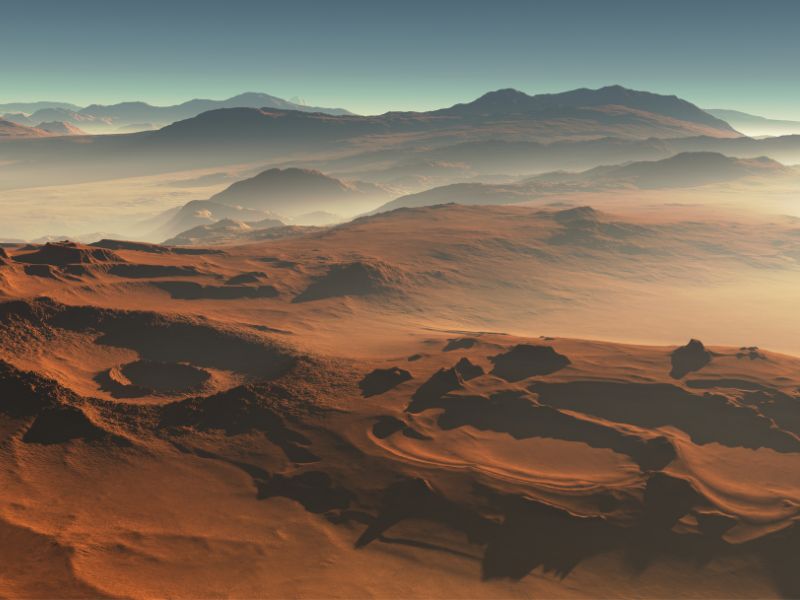
The planet Mars has a climate that is quite different from what we’re used to here on Earth. Still, it’s been highly discussed as the next focus for human space exploration. Engineers and scientists may be interested in the Red Planet because its geological features suggest that its northern hemisphere may have supported liquid oceans in the past. If true, Mars probably had a thicker, warmer atmosphere, and was perhaps once habitable.
Mars Average Temperature
Today, Mars has an average temperature of something like -64 degrees Fahrenheit. Mars’ temperatures can vary widely though. Midday summers at the equator can be as warm as 70 degrees Fahrenheit (20 degrees Celsius). During a winter night near the poles, Mars can be as cold as -200 degrees Fahrenheit (-128 degrees Celsius). For comparison, the coldest temperature ever recorded on Earth was -89.2°C (-128.6°F) recorded in July 1983 (Antarctica).
Despite Mars having an atmosphere that is nearly 95% carbon dioxide (a natural gas that absorbs and reradiates thermal radiation), its atmospheric volume is less than 1% of Earth’s. This means that the planet has a much weaker greenhouse effect than that of Earth’s. Furthermore, Mars is, on average, 50 million miles farther away from the Sun than Earth and consequently does not receive as much light or heat to warm its surface. In other words, Mars doesn’t have an atmosphere thick enough to retain incoming solar heat to keep the average temperature above zero degrees Fahrenheit.
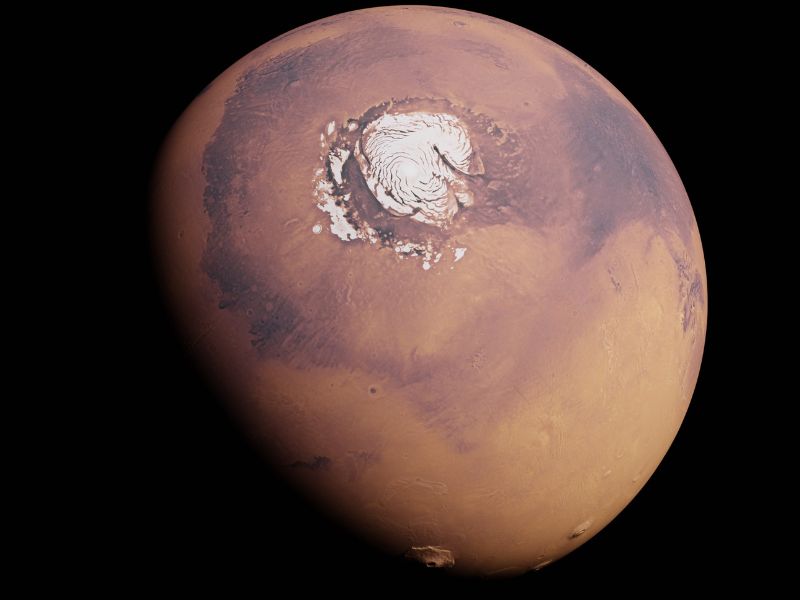
NASA’s Mars Curiosity rover has been exploring the planet’s landscape for over 10 years. The rover was originally equipped with spectrometers (to characterize the composition of planetary minerals), radiation detectors, and various weather sensors. Mar’s rover, in conjunction with a flyby and orbital spacecraft, has revealed ice caps at the poles, along with weather patterns, and seasonal variations.
Average Temperature On Mars
If you stood on Mars’ surface, the wind chill would affect how cold it actually feels. Winds on Mars have a reputation for being powerful enough to create dust storms, occasionally intense enough to be observed by telescopes here on Earth. NASA reports that winds on Mars have been recorded at up to 62 miles per hour (100 kilometers per hour). The average wind speed may be closer to 20 mph.
Like Earth, Martian temperatures change between night and day, but Mars’ elongated elliptical orbit causes temperatures to vary more radically between summer and winter. Mars also has Hadley Cell Circulations, just like Earth does. These weather patterns involve closed currents of heat rising at the equator, splitting in both northward and southward directions, and then falling again as they cool at about 30° latitude where they will eventually return to the equator close to the surface.
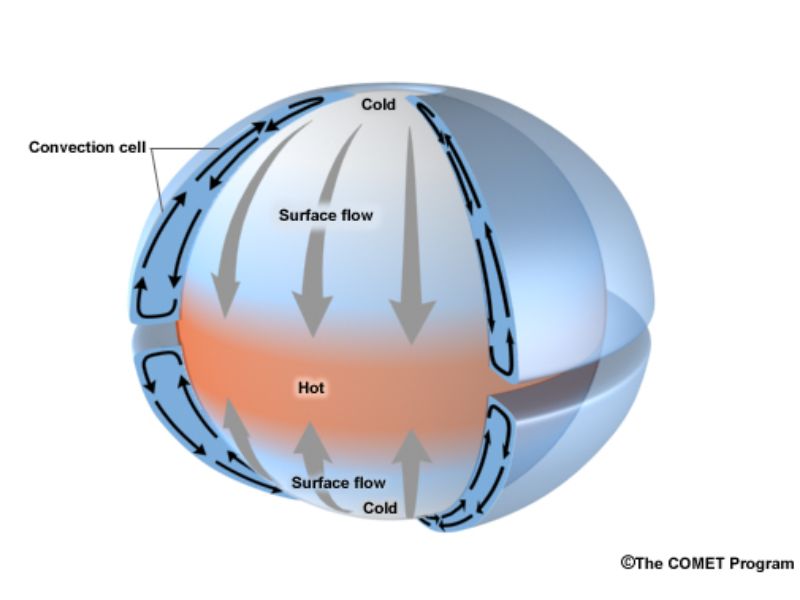
Sunlight that reaches the Martian poles is slanted greater angles due to the planet’s spherical shape. Meaning that light will deliver less energy as its spread out over larger areas with increasing latitude. Mars’ axil spin, keep the planet’s poles facing more or less away from the sun year round, and consequently colder.

