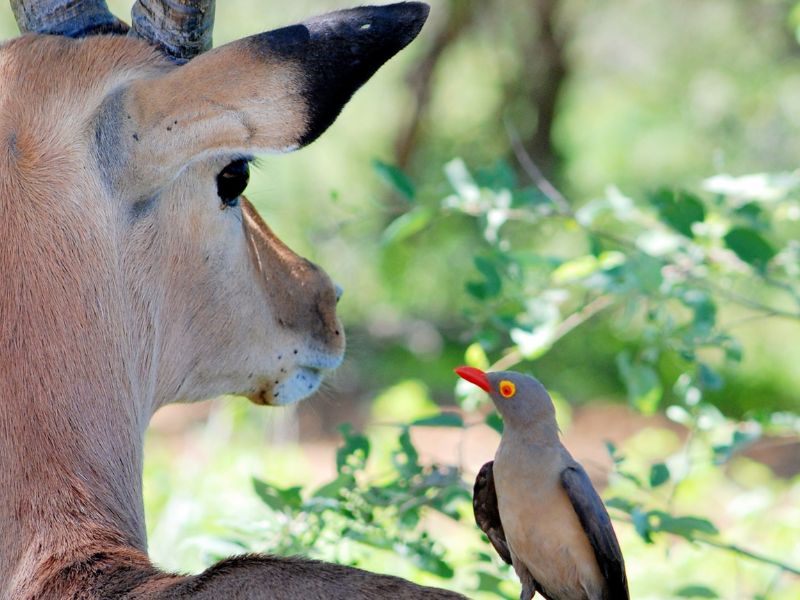
Community ecology as a discipline seeks to answer questions about how species interact and what drives their patterns of diversity and distribution. How species interact can vary greatly. Species exchange nutrients, consume one another, compete for resources like sunlight and space, and help each other out in some cases. There are five main types of interactions between species: competition, predation, mutualism, commensalism, and parasitism. These labels are known as interspecific interactions, and they represent how species are affected by other species that they deal with.
Competition
Competition (-,-) is an interaction in which organisms of two or more species use the same resource. Any given resource will be limited and may have significant costs for either of the organisms involved.
Predation
Predation (+,-) is an interaction that involves one species eating (and in some cases also hunting) another (the latter species is often called prey). Some ecologists extend the term predation to include herbivorous consumption. This is because the general principle at play is one species is consuming another.
Commensalism
Commensalism (+/0) is an interaction in which organisms from one species can benefit at no cost to the other species that it is interacting with.
Parasitism
Parasitism (+,-) is characterized by the benefit of one species at some cost or harm to members of the targeted species. It’s common for parasitic organisms to live inside, or otherwise attach themselves to the targeted organisms (sometimes called hosts).
Mutualism
Mutualism (+,+) occurs when both of the involved species benefit from the interaction, which may motivate a long-term association between them. We explore an example of this type of interspecific interaction below.
Some interactions result in benefits for one species group and disadvantages for the other interacting species group. This interspecific interaction can fit into the parasitism category or the predation category. Interactions of this sort can be simplified as (+/-); the “+” represents the benefit for one species while “-” refers to the detriment of the other. Other interactions can produce mutual benefits for both species, (+,+). In cases like these, it’s not uncommon for there to be a sort of coevolution at work, where both species have evolved specific adaptations to facilitate the services that they provide while also benefiting themselves. We can apply + and – to further depict how species are affected or unaffected by their relationships with one another: competition (-/-), predation (+/-), mutualism, (+/+), parasitism (+/-), and commensalism (+/0). Commensalism is an example in which one species gains some benefit while the other species loses nothing but also gains nothing.
Ecological Community Interaction Example
The relationship between pollinators and plants is a classic example of a mutualistic relationship (+,+) that is rooted in a long and intimate coevolutionary relationship. Pollinators visit flow after flower to collect pollen and other nectars which the pollinator uses as food. Bees are a classic example of pollinators. Bees, like other pollinators, benefit by feeding on nectars and pollens for nutrients. Plants benefit by having their pollen efficiently distributed to other flowers of the same species, this is one way in which flowers pollinate, and another way is by wind-carrying pollens between male and female flowers. Pollination plays an essential role in plant reproduction. Once a female part of a flower (stigma) receives pollen from a male portion (anthers), fertilization can take place.

