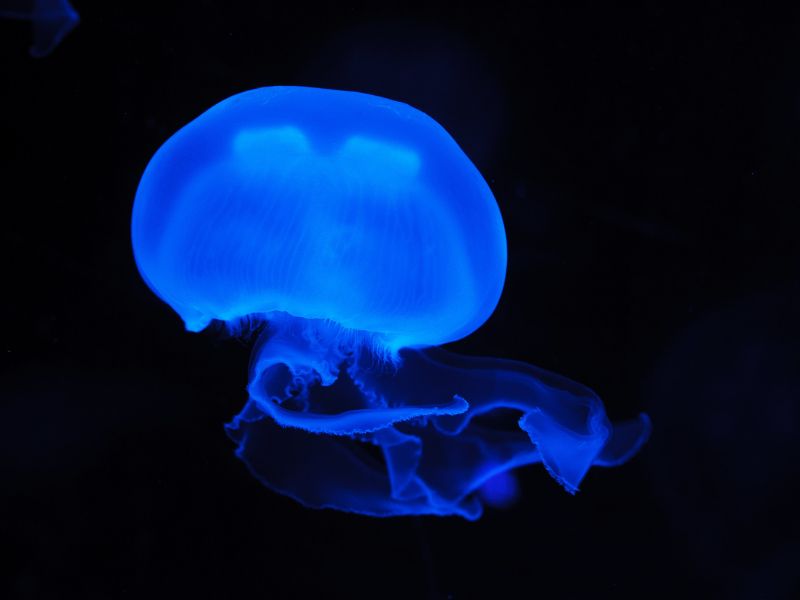
The twilight zone is a layer of sea depth penetrated by significantly less light than what can be found closer to the water’s surface. For this reason, the twilight zone is cold and quite dark, making it unsuitable for most photosynthetic plant species. Twilight zones can be found worldwide and are not unique to any specific body of water.
Twilight Zone Depth
According to the National Oceanic and Atmospheric Administration, the twilight zone can be found at about 200 meters to 1000 meters (650 to 3,300 feet) beneath the water’s surface. This layer range is below the water’s photic layer- the sunlit area, and just above the midnight range.
While some species spend their lives in an undisturbed depth range known as the twilight zone, many animals move in and out. Fish, squid, and plankton species likely swim in darkness to find food orkeep away from predators. These organisms sometimes leave DNA traces in the various ocean regions they travel to.
A new study by researchers, Elizabeth Andruszkiewicz Allan, Michelle H. DiBenedetto, Andone C. Lavery, Annette F. Govindarajan, and Weifeng G. Zhang simulates the physical conditions that cause environmental DNA samples to move through the twilight zones.
Their conclusion: environmental conditions like currents, wind, and mixing do not significantly impact the vertical distribution of DNA samples. To be precise, their computer-generated model demonstrates that eDNA samples didn’t move beyond a 20-meter range of where it was released into the environment. If this model reflects the actual conditions of marine ecosystems in twilight zones, perhaps changes in eDNA concentrations can be used to determine which fish species are present at a sea depth or how long species spend at varying depths. This has groundbreaking implications for tracking marine species travel patterns and migration more generally in aquatic ecosystems.
Twilight Ocean Zone
Vast populations of unexploited fish and unexplored habitats can be found in twilight zones, which make these regions extraordinarily interesting to marine researchers. Environmental DNA may prove useful for learning about organisms that live down in ocean twilight zones and how these species travel. Also, using environmental DNA for sampling can protect the ecological processes and species that inhabit these middle ocean zones.
There is still much to learn about the carbon sequestration potential, ecological processes, and biological diversity profiles of middle ocean twilight zones. Ecosystems must be protected during sampling missions and disturbed as little as possible. Sampling techniques like trawling, bait camera trapping, and other forms of capture carry ethical concerns that could hamper further research efforts.
Twilight zones likely provide ecological services to the network of species that migrate in and out of them, and more permanent inhabitants. To preserve full ecological function and avoid disturbing species, researchers will have to prioritize sampling techniques that are only minimally invasive.

