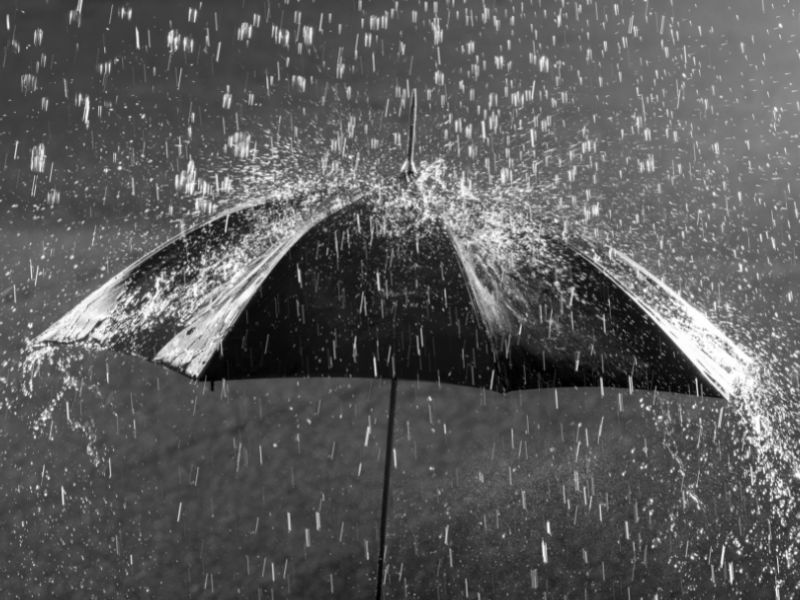
Rain is any liquid water that forms in the atmosphere and is pulled down from clouds by gravity to the Earth’s surface. Water can fall from the sky as liquid or solid. Water droplets with diameters greater than 0.5 millimeters (rain) and smaller droplets (drizzle) are examples of liquid precipitation. Solid forms of precipitation include sleet, snow, and ice crystals.
Precipitation, along with evaporation, condensation, and transpiration, are all facets of Earth’s water cycle, which is the continuous movement of water between the ground, atmosphere, oceans, freshwater systems, underground sources, plants, and animals. During the water cycle, liquid water is converted to a gaseous state via evaporation, transpiration from plants, or the sublimation of ice. If gaseous water molecules accumulate on the surfaces of larger dust or smoke particles, they can form clouds of various types. This is why dust and smoke particles are also referred to as cloud condensation nuclei.
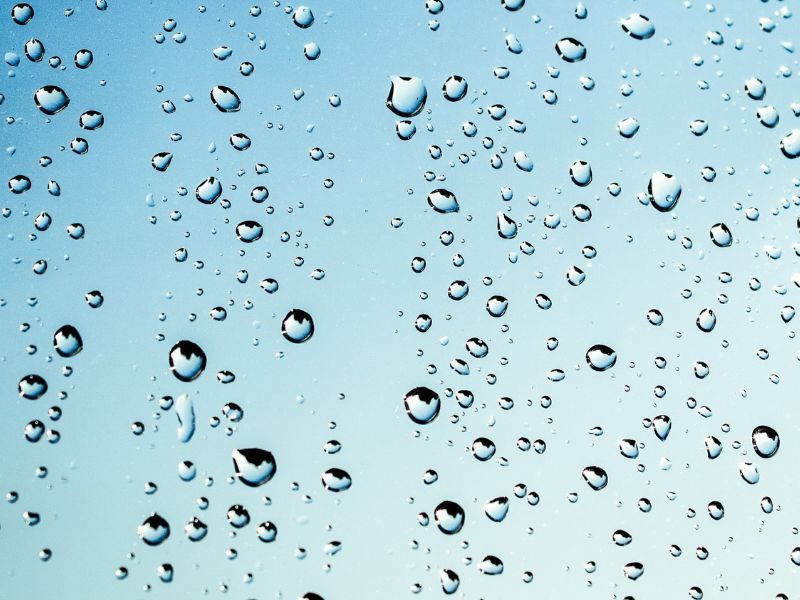
If air and cloud temperatures are cold, as would be expected near the poles or at high altitudes, water is more likely to fall as ice. Nearly all precipitation starts out frozen when it first forms high in the atmosphere. Cold air, then, is important for snowfall to occur. Usually, the air temperature close to Earth’s surface must be lower than 32°F for there to be snow.
However, if the ice crystals happen to fall through layers of warm air, the ice can thaw before landing on the ground as partially frozen water (sleet). This means that precipitation may fall as a frozen solid, or liquid water, or a mixture of both, depending on cloud and air temperatures.
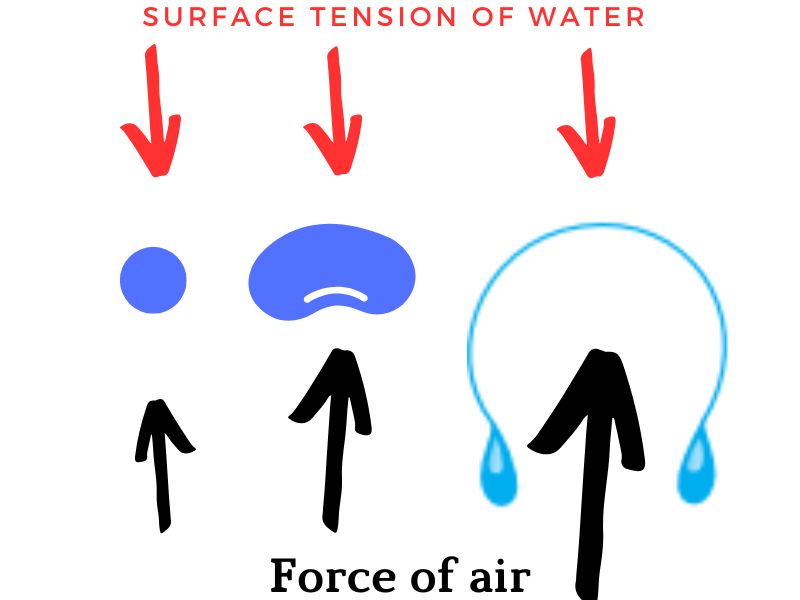
Once water droplets get too heavy to stay suspended in clouds, they are pulled down toward the Earth’s surface by their own gravity. As raindrops fall downward, they can take on spherical shapes. Raindrops are mostly shaped by two forces: the surface tension of the water (water tends to be pulled into a spherical shape by the cohesive forces of the surface layer) and the force of the air pushing upward against the bottom of the droplet as it descends.
Water droplets any smaller than 0.0762 millimeters across will usually have spherical shapes, as the force surface tension keeps the water in somewhat evenly rounded. Larger droplets, 0.0762 millimeters or larger in diameter, sometimes take on a hamburger bun shape, rounded on top with a flat or dented bottom. As the force of air increases, the dents grow larger, causing the to take on shapes resembling parachutes. This dent created by the force of air can be strong enough to split water droplets into smaller multiples.
What Is Rain Percentage
The rain percentage, sometimes referred to as the probability of precipitation or PoP, is the probability that a given region will receive at least one-hundredth of an inch of precipitation. To put it another way, rain percentage is the statistical likelihood of at least 0.01″ inches or more of precipitation for a specific area.
So, there are two factors at play in this definition: the forecaster’s confidence that rain will fall and the expected extent of the precipitation in the area. These two factors are multiplied to give us PoP. This can be expressed as PoP = C x A. Here, C stands for confidence of the forecaster and A represents the area that is expected to be affected.

