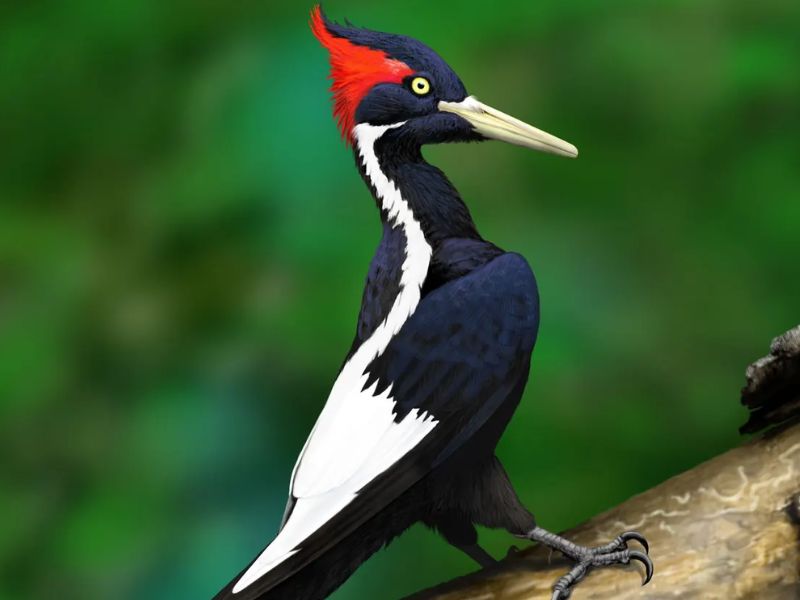
The Ivory-Billed woodpecker (endemic to the southeast United States and Cuba) is a black bird with elongated white coloring from its neck down to its wings. The bird can be easily spotted by the bright red feathers on its head. The last verified sighting of an ivory-billed woodpecker occurred back in 1944.
Ivory Billed Woodpecker Sightings
In 2021, the United States Fish and Wildlife Service has just declared more than 20 species extinct including one plant, a bat, two fish, eight freshwater mussels, and eleven birds. One of the more popular birds is the ivory-billed woodpecker (Campephilus principalis). This bird hasn’t had a confirmed siting in decades, and thus, some officials have concluded that the bird has died out entirely. Once a species has been officially declared extinct, it’s likely that searches will cease completely, placing limits on conservation efforts, funding, and incentives for further research on the species.
The potential disappearance of the ivory-billed woodpecker foreshadows the looming fate of species in wetlands around the world, as these ecological systems are especially sensitive to flooding, temperature fluctuations, and drought. Extinctions can have several different causes. In some cases, the causes may be naturally occurring: changes in average temperatures or climate could make an environment unsuitable for habitation or reproduction. Another possibility, a disease eradicates the members of a species. That said, we can not rule out human activities as a possible proximate cause of the ivory-billed woodpeckers’ disappearance. If this is the case, environmental degradation would likely have been a driving force.
Ivory Billed Woodpecker Habitat
The destruction and logging of America’s forests could have played a role in shrinking populations of the ivory-billed woodpecker. The ivory-billed woodpeckers are known to inhabit forests close to water. The trees of wetlands are usually where they make their nests.
Wetlands are environments where water inundates land either seasonally or year-round. Wetlands exist on almost every landmass on Earth and are characterized by the specialized type of vegetation that grows in wet soil. There are multiple kinds of wetlands: coastal wetlands exist along coasts and are tolerant of saltwater. inland or non-tidal, on the other hand, interact with freshwater rivers or streams.
Wetlands are hailed as nurseries for wildlife because of the vast amount of wildlife that is supported within them. Protecting wetland biodiversity will effectively help preserve unique species of plants, animals, and microorganisms. Proper management of these ecological systems will greatly enhance the odds of salvaging other types of organisms and protect the ecological services that they provide.

